Introduction
For small and medium-sized enterprises (SMEs) in the Netherlands, financial administration often eats up hours that could be spent growing the business. Between BTW (VAT) filings, invoicing, payroll, and reconciliation, routine finance tasks pile up fast — especially for lean teams without a dedicated finance department. Artificial intelligence is changing that. Dutch SMEs are increasingly adopting AI-powered tools to automate repetitive financial work, reduce human error, and free up time for strategic decisions. This guide covers exactly how — and where to start.
Why Dutch SMEs Are Turning to AI for Finance
The Netherlands has one of Europe's highest small-business densities, and Dutch SMEs face specific pressures:
- Complex BTW/VAT compliance with the Belastingdienst
- Tight margins that make manual bookkeeping costly
- Labor shortages, making it harder to hire dedicated finance staff
- Digital-first banking, which creates ready-made data for automation
These conditions make Dutch SMEs a natural fit for AI-driven financial automation.
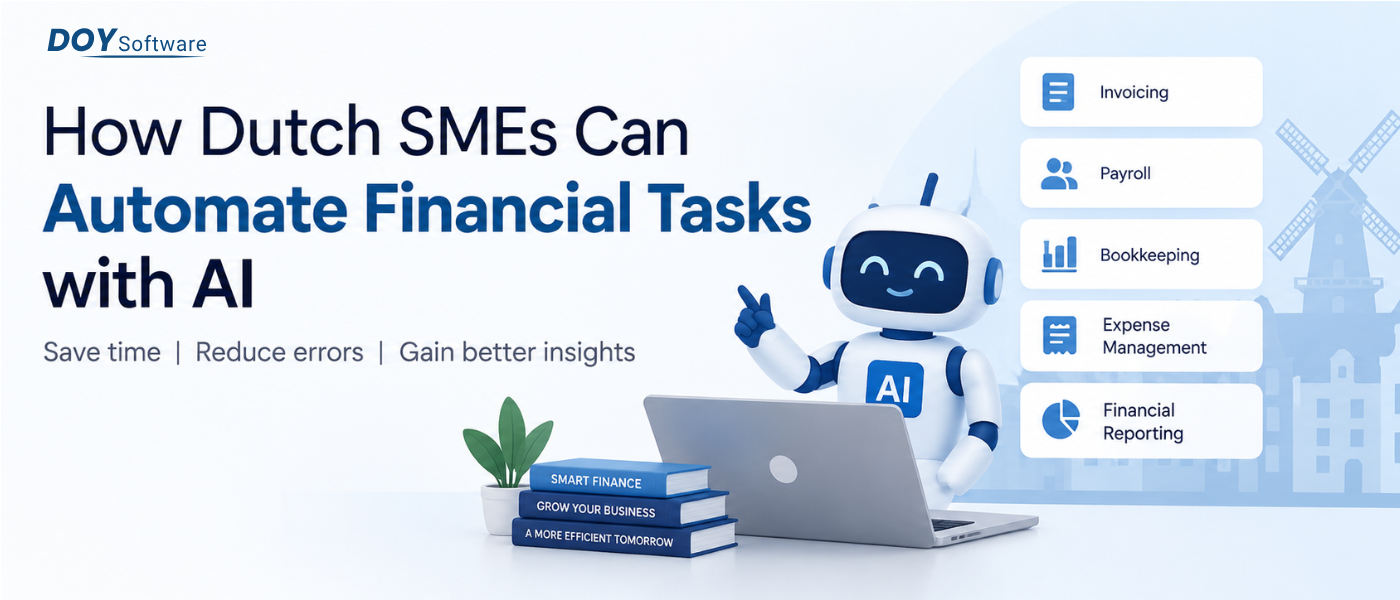
5 Routine Financial Tasks Dutch SMEs Can Automate with AI
1. Invoice Processing and Matching
AI tools can automatically extract data from incoming invoices (OCR + machine learning), match them to purchase orders, and flag discrepancies — reducing manual entry and payment delays.
2. Bookkeeping and Categorization
AI-powered bookkeeping platforms (many integrated with Dutch accounting standards) auto-categorize transactions, reconcile bank feeds, and prepare data for BTW filings.
3. Cash Flow Forecasting
Machine learning models analyze historical transaction data to predict cash flow gaps weeks in advance — critical for SMEs managing tight working capital.
4. Expense Management
AI apps scan receipts, auto-classify expenses, and flag policy violations or duplicate claims — cutting down on manual expense report reviews.
5. Financial Reporting
AI-generated reports can summarize monthly performance, highlight anomalies, and even draft management commentary — saving hours normally spent building spreadsheets.
Popular AI Finance Tools Used by Dutch SMEs
| Task | Example Tool Types |
|---|---|
| Bookkeeping | AI-integrated accounting software (e.g., Moneybird, Exact Online with AI add-ons) |
| Invoice automation | OCR/AI invoice processors |
| Forecasting | AI cash flow platforms |
| Expense tracking | Receipt-scanning apps with ML categorization |
Benefits of AI Automation for Dutch SMEs
- Time savings: Hours per week reclaimed from manual data entry
- Fewer errors: AI reduces human mistakes in categorization and reconciliation
- Better compliance: Automated BTW-ready data reduces late or incorrect filings
- Improved cash flow visibility: Forecasting tools help avoid liquidity crunches
- Scalability: Automation scales with business growth without proportional headcount increases
Getting Started: A Simple Roadmap
- Audit your current financial workflows — identify the most repetitive, time-consuming tasks
- Start with one process (e.g., invoicing) rather than automating everything at once
- Choose Netherlands-compliant tools that integrate with Dutch banking and BTW systems
- Train your team on reviewing AI outputs, not just running them blindly
- Measure results — track time saved and error reduction after 90 days
Conclusion
AI-driven financial automation isn't just for large enterprises — it's increasingly accessible and practical for Dutch SMEs looking to cut administrative overhead and make faster, data-backed decisions. Starting small, with tools built for the Dutch regulatory environment, is the safest path to meaningful efficiency gains.